 |
ARMS and WEAPONS |
|||||
|
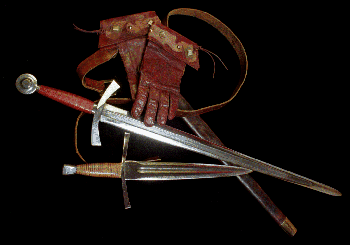
The broadsword, although not a musical instrument was an essential part of the collection of any early musician with common sense! To earn money, musicians had to travel around the country, often alone and often on foot. If a musician had just finished playing in a particular village - or, if he got lucky, a castle, where the inhabitants were richer - he would be an obvious target for the outlaws and robbers who lived rough in the woods between settlements. So the minimum requirement would be a dagger. Better still would be a good sharp broadsword: both are shown in this photograph. The sword shown is an accurate copy of a 12th century broadsword (so called because of its wide blade), more or less identical to those carried at the Battle of Hastings by the Norman knights of William the Conqueror in 1066. Designed primarily as a cavalry weapon, the broadsword is single-handed (since the knight would have carried a heavy kite shield on the other arm) and double edged. Since it was designed to deliver maximum damage from a mounted position, the blade is deliberately heavy and off-balance, which makes it ideal for a single devastating downward cut but rather awkward to rotate quickly on the wrist - unlike later renaissance swords made for personal protection which were designed for fast swordplay without shields (think of the fight between Romeo and Tybalt in Shakespeare's Romeo and Juliet). The broadsword is made from spring steel, tempered and hardened using the same process of heating, hammering and sudden cooling which the Norman armourers used a thousand years ago. Its leather scabbard is made from cowhide, hand-sewn and vegetable dyed like the Norman originals and finished with a decorative brass end-plate. |
||||||
|
||||||
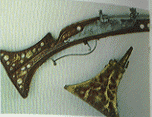 |
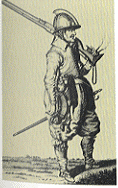
The most important development in weapons was the introduction of the firearm to replace the archer with his longbow and the heavily armed cavalry. The earliest hand-guns, however, were cumbersome and unreliable. The match or fuse and the charge of gunpowder had to be kept dry and the guns were slow to fire. But by the beginning of the 1580s the last English longbow was hung on the wall. | |||||
|
|
||||||

Text copyright © James McCafferty 2000 Photographic images copyright © John Credland and James McCafferty 2000