 |
LIFE & TIMES |
|
| The peopled streets - 'from dawn to dusk the city echoes with the clatter of workshops and cries
of traders and jobless beggars jostle gallants in their finery' In Elizabethan times England had a population of nearly 5 million. By the end of Elizabeth I's reign 80% were countrymen and 20% lived in cities and towns although town dwellers still had substantial patches of land. Many had orchards and gardens and no town centre was more than a brief walk from the countryside. Apart from London, there were only a handful of other towns that were of any consequence: |
|
|
|
|
||
| Manchester - An ancient market town, growing and doing well
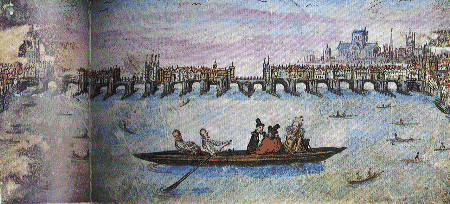
out of rough woollens exported through the port of Chester, though it had not yet achieved the status of a borough. Leeds - Also not yet a borough though making significant trade in woollen goods. Birmingham - Growing fast and noisily with the anvils of its metal workers, but still a manorial village governed by the lord of the manor. Sheffield - Another manorial village developing a name for the quality of its knives and scythes. Newcastle - Growing and expanding in profitable trade sending coal to London by sea (hence the expression 'sea coal'). York - Most important and ancient city, administrative capital of the north. In the midlands Ludlow and Shrewsbury were cloth and market towns, Coventry had a thread making industry and Leicester with a population of 3000 - 4000 relied on cattle and its tanneries. As today, the bulk of England's wealth and trade was found in the South. Indeed, after London the second biggest manufacturing town was Norwich, centre of the textile industry with a population of 17,000 while the flourishing port of Bristol ran it a close third. Elizabethan England saw the rise of Plymouth from an insignificant fishing village to a vital naval base guarding the mouth of the English Channel. The heart and soul of Elizabethan England was the City of London, bounded by the river and by its ancient Roman and medieval walls and fortifications. These followed a roughly semi-circular line from the Tower in the east via Aldgate, Bishopsgate, Moorgate, Cripplegate and Aldersgate, (still with their battlemented towers and closed at night fall) to Newgate and Ludgate - both used as prisons. The Elizabethan city had expanded west and then (as now) Temple Bar marked the frontier where the Lord Mayor's jurisdiction ended. London was full of great mansions as well as absolute squalor with streets running with raw sewage. Nevertheless, the narrow, congested streets were busy and had frequent traffic jams. There was a constant din, clatter and hammering from a thousand workshops, the rumble and squeak of cart wheels and the lowing of cattle being driven to market as well as the shopkeepers in their doorways shouting 'What do ye lack?' to potential customers. Newcomers would have been shocked by the sheer size of the crowds with the pickpockets, and cutpurses - so-called because they cut off the purses that people carried attached to their belts. London's day began at 5am when the carts laden with goods from outlying farms and villages began to rumble into town. London, like most towns and cities, was ruled by a merchant elite. It was divided into 26 wards each of which elected an alderman who held office for life. The aldermen in turn elected one of their number to be Lord Mayor and appointed the recorder, who was their legal advisor and spokesman and generally ran city affairs. The Lord Mayor and aldermen were all freemen of the city and as such belonged to one of the livery companies, so called because members wore clothes of a certain colour and style (a uniform of sorts). These companies had evolved from the medieval guilds. They had real power. No one was permitted to buy or sell in London and no one might practise any trade or craft without being a member. The livery companies, though, didn't only take - they also gave in their role as benefit societies for their members. They helped widows and orphans and those who had fallen on hard times; they maintained alms houses and schools, such as St Paul's; and the Merchant tailors sponsored promising scholars and sometimes provided funds to enable a likely young man to set up in business. There were twelve great Livery Companies: Merchant tailors, clothmakers, mercers (importers and wholesalers of silks and luxury fabrics), grocers (importers and wholesalers of commodities such as sugar and currants for sweetmeats as well as spices, a necessity in days when pickling and salting were the principal methods of preserving food), drapers and fishmongers, the goldsmiths, skinners, haberdashers, salters, ironmongers and vintners. Among the lesser of the companies were the cordwainers (manufacturers of fine leather goods), the dyers, plasterers and stationers (or printers). Although not first in precedence, the goldsmiths were the wealthiest and most influential of the companies, acting as they did in the role of merchant bankers and financiers. However, behind the fine new houses of the merchants and middle classes with their sumptuous shops lurked squalid, rat infested slums - the so called rookeries - where whole families were crowded into one room of some old derelict mansion long since abandoned by aristocratic owners migrating westwards to a smarter address. Laws forbidding multi-occupation unfortunately clashed with other laws which sought to prevent new building within a three mile radius of the city limits. The urban poor formed a shifting, rootless mass made up of dispossessed country dwellers who had drifted into town in the hope of work, of discharged soldiers, masterless men, natural vagrants and misfits of both sexes, too illiterate and insignificant to leave a mark on the record of life. They supported themselves as best they could by petty crime, begging and by casual labour - or all three - and they lived from hand to mouth on the fringes of society, eating when they were lucky and all too often ending short, miserable lives on the gallows. |
||
Text copyright © James McCafferty 2000 Photographic images copyright © John Credland and James McCafferty 2000