|
||||
| DICK DAVISON meets a musician who takes children on an historical journey through music. | ||||
|
||||
| The unexpected and incongruous juxtaposition of early music and microlights is the first clue that McCafferty's
peripatetic voyage of discovery through 15 centuries of musical history is going to be no dry academic exercise.
Anyone who both knows about the history and development of the crumhorn and can tell you how to stay alive while
suspended by a kite and a lawn mower motor is clearly no ordinary enthusiast. Ex-primary deputy head McCafferty has been taking his personal collection of early instruments - wind, string and percussion - into schools for four years, "whipping up," as he puts it, "a frenzy of interest in early music, the Tudors, and the Middle Ages." Not to mention the Renaissance, the Crusades and the invention of the recorder, 2,000 years ago. |
||||
 |
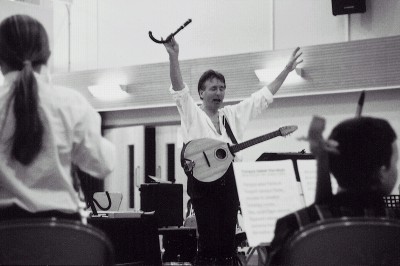
"Frenzy" might be a bit strong; prep schools don't, on the whole, do frenzy. But watching his 75-minute demonstration, followed by two hour-long music workshops with smaller groups, at St Faith's School, Cambridge, one can easily see why he is so popular with prep schools in particular. For a start, he cuts a striking figure dressed in what he describes as an "all-purpose twelfth to sixteenth century" costume - tunic with studded leather sleeves, fustian brown hose, cross garters and boots - and armed with a lethal-looking broadsword. Authentic it may not be, as he cheerfully admits, but he certainly cuts a dash. Even before a note has been played on the instruments, he has the children's attention. | |||
| And there's nothing phoney about the instruments. They may be modern replicas, but McCafferty's day at any school
has to start early because the instruments are delicate and have to acclimatise. For a morning demonstration, therefore,
he will arrive no later than 7am. The demonstration itself is so packed with music, stories, songs and bits of history that the hour and a quarter is clearly inadequate. Demonstrating the dulcimer, he asks: "Who recognises this tune?", and launches into Good King Wenceslas. Up go a dozen hands and, the answer duly given, he tells them the history of the tune, first recorded in Sweden in 1582 (and nothing whatever to do with the King of Bohemia). Then it's into another song, the Serving Girls' Holiday, introduced to incredulous gasps from ten-year-olds previously unaware that, until relatively recently, working people got only two days off a year. From there it's off to the Crusades, to explain the history of the rebeck, the great-great-grandfather of the violin family, and its origin in the middle east as an instrument made from a hollowed gourd. Then, by way of Renaissance battlefields (the long drum), and Henry VIII's collection of crumhorns ("the only instrument that looks like a walking stick") we get to an impromptu ensemble. One of the girls plays a single note drone on the rebeck and a boy with the renaissance drum (the boys always want to play the drum), accompanying McCafferty in a Michael Praetorius dance - "one of his hit singles of 1607." Over coffee in the staff room, before starting workshops with smaller groups of children playing their own instruments, he explains how his early music demonstrations grew out of two major strands in his own life. An entirely self-taught musician (he plays all the instruments except the rebeck), his interest in early instruments arose from his involvement in morris dancing and folk music. And his skill with children comes from nearly 20 years as a primary teacher in state schools, which came to an end about a decade ago when, driven out by the paper chase of the national curriculum in the early 90s, he became a civil servant. During that time, however, he ran an early music group, Milady Clare's Musicke, whose repertoire demonstrated his belief that early music performance should combine musical sophistication and earthy popularity. "Music," he says firmly, "must be fun." It was in1997 that he decided he could put together his teaching experience with his musical enthusiasm and launched himself (except at weekends, when he teaches people to fly microlights) on to his current path. The schools which book him are mostly independent (sadly, he says, most state schools haven't got a large enough music budget to book him) and, while it is mostly music departments who engage his demonstrations, he finds himself contributing to the history syllabus sometimes too. St Faith's director of music, Peter Burge, who has had McCafferty in the school twice, is enthusiastic about what he brings to the pupils: "He is a total enthusiast. His passion for the music is communicated from the very first moment. The children respond very well and they always have a very stimulating day; they are particularly fascinated to discover the links between familiar tunes and their medieval or renaissance background." But it helps, he adds, that the pupils have done some Latin! |
||||

Text copyright © James McCafferty 2000 Photographic images copyright © John Credland and James McCafferty 2000